
L’ophiure du film « Cap Corse : le mystère des anneaux » dans un article publié dans Zootaxa
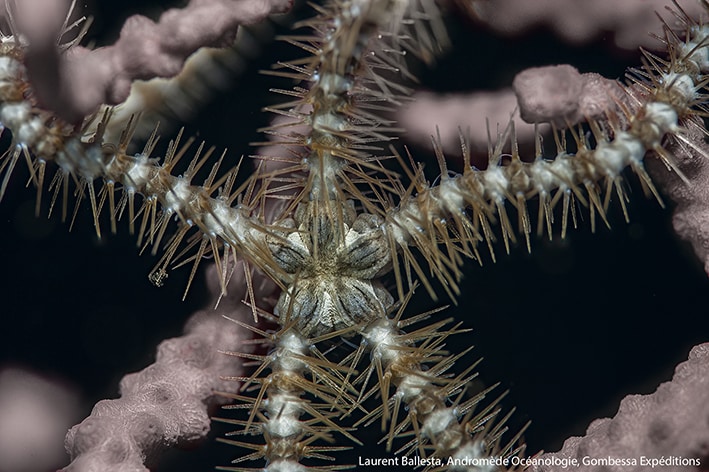
L’ophiure du film « Cap Corse : le mystère des anneaux », vous vous souvenez ? Après la page sur Doris, la voici au coeur d’un article fraichement publié. Une petite note qui se transforme en un joli article scientifique publié dans Zootaxa, bien complet grâce à une chouette collaboration.
Ducarme, F., Jéglot, S., Réty, C., Deter, J., Ballesta, L. & Stöhr, S. (2026) Uncovering a poorly known Mediterranean species thanks to underwater photography and video: Ophiacantha setosa (Echinodermata: Ophiuroidea). Zootaxa, 5862 (3), 472–486. https://doi.org/10.11646/zootaxa.5862.3.4.
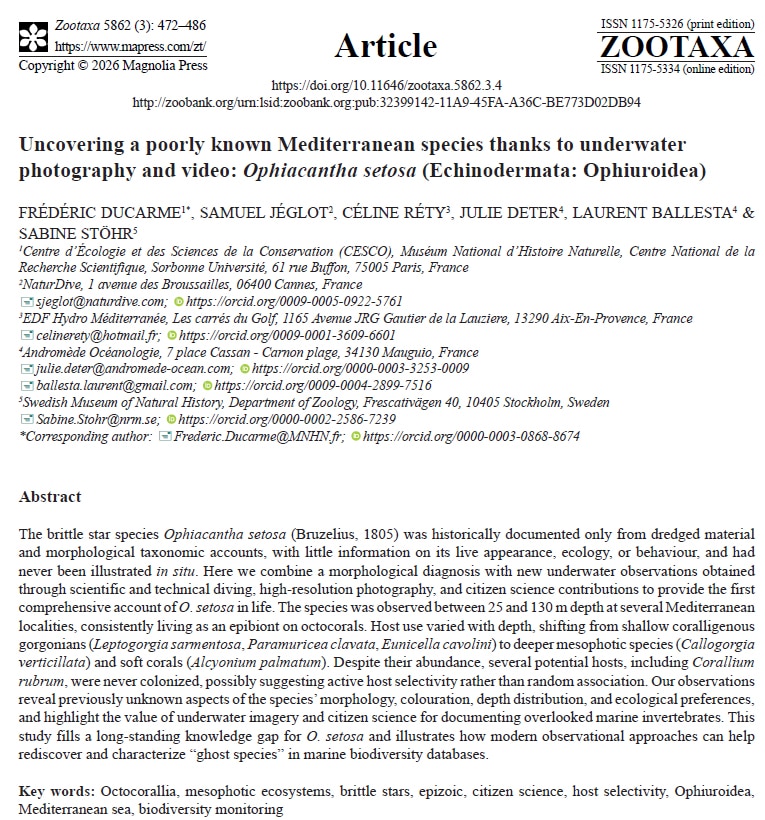
Abstract: The brittle star species Ophiacantha setosa (Bruzelius, 1805) was historically documented only from dredged material and morphological taxonomic accounts, with little information on its live appearance, ecology, or behaviour, and had never been illustrated in situ. Here we combine a morphological diagnosis with new underwater observations obtained through scientific and technical diving, high-resolution photography, and citizen science contributions to provide the first comprehensive account of O. setosa in life. The species was observed between 25 and 130 m depth at several Mediterranean localities, consistently living as an epibiont on octocorals. Host use varied with depth, shifting from shallow coralligenous gorgonians (Leptogorgia sarmentosa, Paramuricea clavata, Eunicella cavolini) to deeper mesophotic species (Callogorgia verticillata) and soft corals (Alcyonium palmatum). Despite their abundance, several potential hosts, including Corallium rubrum, were never colonized, possibly suggesting active host selectivity rather than random association. Our observations reveal previously unknown aspects of the species’ morphology, colouration, depth distribution, and ecological preferences,
and highlight the value of underwater imagery and citizen science for documenting overlooked marine invertebrates. This study fills a long-standing knowledge gap for O. setosa and illustrates how modern observational approaches can help rediscover and characterize “ghost species” in marine biodiversity databases.
Article complet en accès gratuit sur Researchgate ou Hal
Article publié dans Zootaxa réservé aux abonnés : https://mapress.com/zt/article/view/zootaxa.5862.3.4